1565 · Navigation
The 1565 tornaviaje: the return route that made the Manila Galleon possible
How Andrés de Urdaneta and Felipe de Salcedo found the return route from the Philippines to New Spain in 1565, what the sources say, and where their dates disagree.
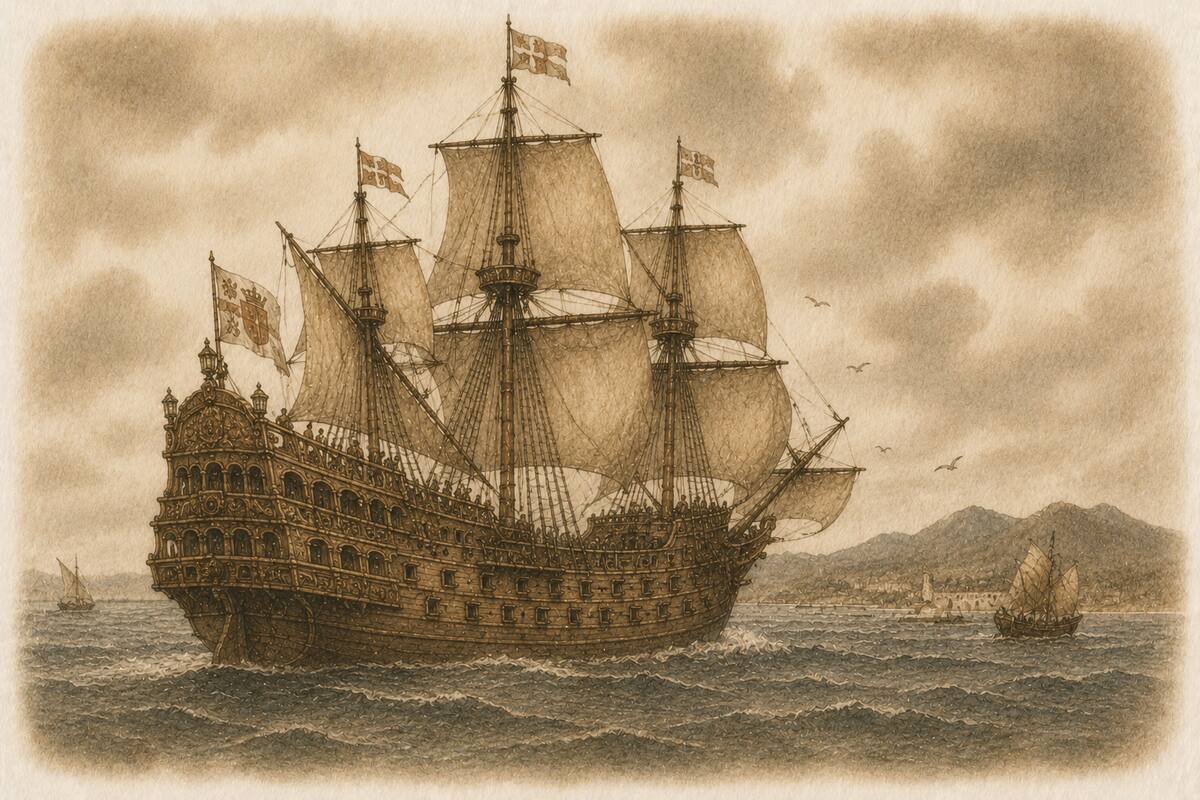
For more than forty years, Spanish expeditions that crossed the Pacific to Asia could not get back: the trade winds that carried them west blocked the way home. Solving that return voyage — the tornaviaje — was the precondition for any regular trade between Asia and the Americas.
In 1565 the San Pedro, commanded by Felipe de Salcedo — grandson of Miguel López de Legazpi — with the Augustinian friar Andrés de Urdaneta as guide, sailed from Cebu, climbed to high latitudes to catch the westerlies and reached the coast of New Spain. That northern track remained the galleons' route for 250 years.
The sources agree on the essentials but not on the details: the departure date, the day of arrival in Acapulco, even who arrived first. Before the San Pedro, Alonso de Arellano's San Lucas reached New Spain, a crossing many historians push into the background.
92 statements21 sources3 discrepancies
Ask the atlas →How was the Pacific return route (tornaviaje) found in 1565?
Where the sources disagree
When did the San Pedro leave the Philippines in 1565?
The galleon San Pedro left Luzon behind on June 10, 1565, and emerged into the open ocean through the San Bernardino Strait. (machine-translated)
The San Pedro departed from that Philippine island on June 1, 1565. (machine-translated)
They do not necessarily contradict each other: one date may mark the departure from Cebu and the other the passage to open sea through the San Bernardino Strait, days later.
Detected automatically · reviewed by a personDid the San Pedro sail in May or June 1565?
The nao San Pedro, carrying friar Andrés de Urdaneta, sailed from Cebu in May 1565 with cinnamon in its holds bound for New Spain. (machine-translated)
The so-called tornaviaje was started by the San Pedro on Friday, June 1, 1565, from the island of Cebu. (machine-translated)
The account collected by Blair and Robertson and the Real Academia de la Historia biographies give 1 June 1565; “May” appears in a modern study and may refer to the preparations for the voyage or simply be imprecise.
Spotted while preparing this pageDid it reach Acapulco on 1 or 8 October?
The flagship, under command of Phelippe de Salzedo and Fray Andrés de Urdaneta, set sail on June 1, 1565, and reached Acapulco on October 1, 1565, without stopping at La Navidad.
Urdaneta set a course east to take advantage of the westerly winds and easily reached Acapulco on October 8. (machine-translated)
A week apart for the arrival. Period accounts sometimes record the first landfall on the coast and sometimes the entry into port, which may explain the different dates.
Spotted while preparing this pageWhat the sources say
A selection of the corpus statements on this topic, grouped by source.
Relation of Discoveries (Blair & Robertson, Vol. III)
- On May 28, 1560, Fray Andrés de Urdaneta wrote from Mexico that he had received the decree of September 24 and offered himself to undertake the expedition.
Expedition of Loaisa (Blair & Robertson, Vol. II)
- Andrés de Urdaneta returned to Spain in 1535 after staying in the Moluccas contending with the Portuguese.
Los sangleyes chinos en el comercio novohispano
- In May 1565, from Cebu the ship San Pedro was sent under the command of Felipe de Salcedo and carrying Fray Andrés de Urdaneta to seek the Tornaviaje route to New Spain. (p. 135, machine-translated)
- Fray Andrés de Urdaneta recommended to Viceroy Luis de Velasco that the expedition being prepared at Puerto de Navidad sail from Acapulco in 1564, under the command of Miguel López de Legazpi, who would found Manila in the Philippines. (p. 194, machine-translated)
- In May 1565, Governor Legazpi sent the ship San Pedro de Filipinas, of 500 tons and 200 men, under the command of Felipe de Salcedo and Andrés de Urdaneta, from Cebú to New Spain. (p. 35, machine-translated)
Los hallazgos españoles en el Pacífico
- The San Lucas arrived in New Spain before Fray Andrés de Urdaneta. (p. 11, machine-translated)
- Many historians relegate to a secondary place the voyage of Alonso de Arellano between the Philippines and New Spain, giving primacy to that carried out by Urdaneta, because the account of the first crossing is very sparse in nautical data. (p. 12, machine-translated)
Discusiones en torno a las marinerías transpacíficas. El caso de la duplicidad de plazas en el Galeón de Manila Santísima Trinidad, 1752-1753
- After fray Andrés de Urdaneta's return voyage in 1565, the certainty of the new route for maintaining maritime contacts between the Philippines and New Spain was established. (p. 6, machine-translated)
El Galeón de Manila: mercancías, personas e ideas viajando a través del Pacífico (1565-1815)
- The nephew of Legazpi, Felipe de Salcedo, along with the Augustinian friar Andrés de Urdaneta, succeeded in finding the return route or navigation route from the Philippines to New Spain. (p. 2, machine-translated)
Preface (Blair & Robertson, Vol. II)
- The instructions of the Audiencia to Legazpi on September 1, 1564, stress the necessity of discovering a return route from the Philippines; Urdaneta is ordered to return with the ships sent back to New Spain for this purpose.
España y el Pacífico: un breve repaso a las expediciones españolas de los siglos XVI al XVIII
- Finally the return voyage was found after ascending to 40° latitude and heading towards the coast of California, arriving in the port of Acapulco in October 1565. (p. 6, machine-translated)
Miguel López de Legazpi
- On June 1, 1565, the flagship San Pedro, commanded by Felipe Salcedo and accompanied by Urdaneta, set sail; Urdaneta's nautical knowledge opened the tornaviaje route, arriving at the port of Navidad on October 1, 1565. (machine-translated)
Andrés de Urdaneta y Ceraín
- Viceroy Velasco requested authorization from Philip II to carry out an expedition in the Pacific and the King granted it in 1559 under the condition of going to the Philippine Islands without touching the Malucas area, with the objective of discovering the return route. (machine-translated)
Ruy López de Villalobos
- The impossibility of continuing the return voyage led the crew to return to Tidore, where they arrived on October 3, 1545, ending the sixth unsuccessful attempt to find the westward return route. (machine-translated)
Frequently asked questions
What was the tornaviaje?
It is the name given to the return route from Asia to the Americas across the North Pacific. The San Pedro found it in 1565, and from then on the galleons could sail every year between Manila and Acapulco.
Who discovered the return route: Urdaneta or Arellano?
Alonso de Arellano's San Lucas reached New Spain first, but tradition credits Urdaneta and Salcedo; one source in the corpus attributes this to Arellano's account being thin on navigational detail.
When did the San Pedro reach Acapulco?
The sources differ: a period account collected by Blair and Robertson gives 1 October 1565, while the Real Academia de la Historia biography of Urdaneta gives 8 October. Both describe a crossing of about four months.
How this page was made: the introduction was written with AI assistance from the project's corpus and checked against its sources. The statements listed are paraphrases extracted automatically from each source (and translated when the source is in another language); they may contain errors, so check the linked original source. Last updated: 2026-10-19.