1494–1529 · Diplomacy
Tordesillas, the Moluccas and the Treaty of Zaragoza
Why Castile and Portugal fought over the Spice Islands, how the Tordesillas line was drawn and what Charles V gave up at Zaragoza in 1529. Sources and contradictions.
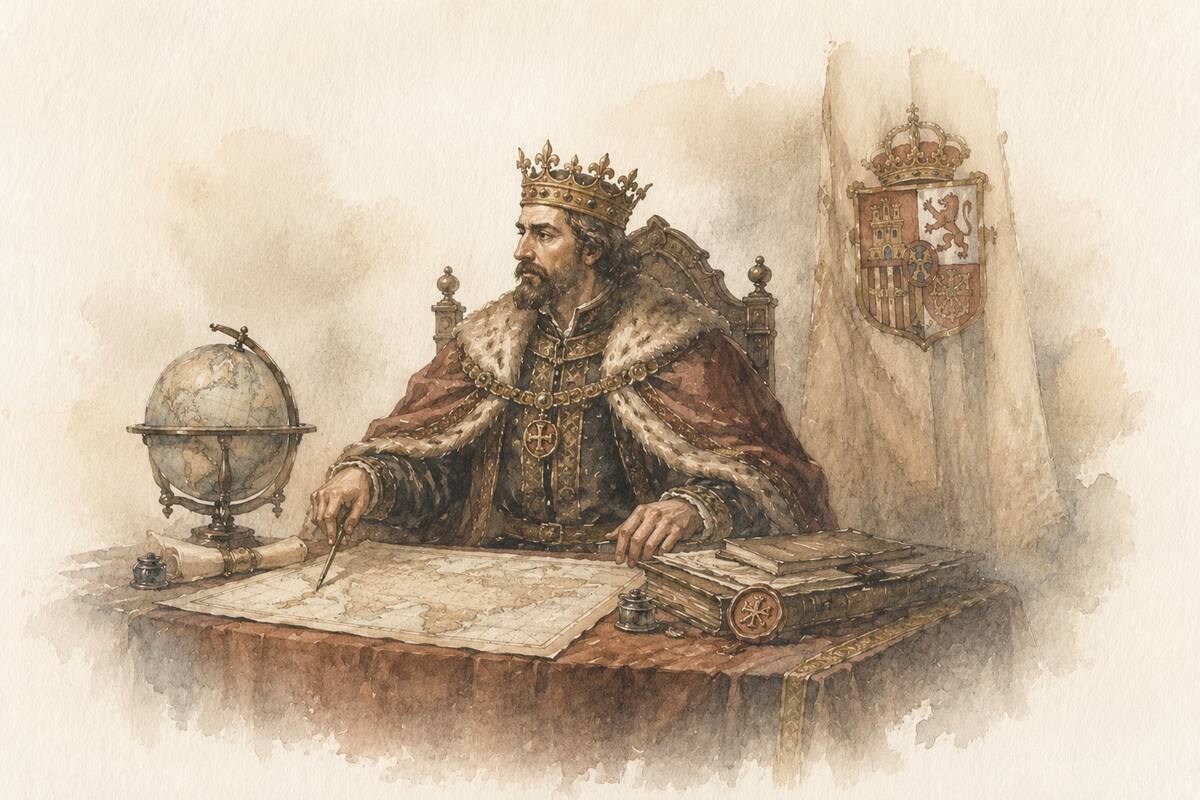
The Treaty of Tordesillas (1494) divided the world between Castile and Portugal with a line drawn in the Atlantic, 370 leagues west of the Cape Verde islands. Nobody knew where the opposite line ran on the other side of the globe — and it mattered, because the Moluccas, the Spice Islands, lay there.
After Magellan's voyage both crowns claimed the Moluccas. The Junta of Badajoz (1524) failed to settle the dispute, because the instruments of the time could not measure longitude accurately. In 1529, by the Treaty of Zaragoza, Charles V ceded his claims to the Moluccas to Portugal for 350,000 ducats.
Under that agreement the Philippines, west of the Moluccas, fell on the Portuguese side; Castile colonised them anyway from 1565. Several of the “contradictions” the system detects on this topic are really different readings of the same figures, as explained below.
336 statements67 sources5 discrepancies
Ask the atlas →What was the Treaty of Zaragoza and why were the Moluccas disputed?
Where the sources disagree
Tordesillas: 370 or 270 leagues?
In the Treaty of Tordesillas, the delimitation of the demarcation zone was established at 370 leagues west of the Azores and Cape Verde. (machine-translated)
The Portuguese Court accepted the papal arbitration of Pope Alexander VI but moved the demarcation line 270 leagues west, establishing the Treaty of Tordesillas in 1494. (machine-translated)
Not a real contradiction: the Tordesillas line was moved 270 leagues further west than the one set by Pope Alexander VI (100 leagues), which gives the treaty's 370 leagues.
Detected automatically · reviewed by a personDid the Moluccas lie in the Spanish half of the world?
The islands they call the Moluccas, where all spices are produced and exported to Malacca, lie within the Spanish western division.
King Charles I of Spain delivered the Moluccas islands to Portugal through the Treaty of Zaragoza in 1529 in exchange for 350,000 ducats. (machine-translated)
Both statements reflect different moments: Castilian cosmographers held that the Moluccas fell in the Spanish half, and in 1529 Charles V gave up that claim in exchange for money.
Detected automatically · reviewed by a personWhen did Bartolomeu Dias round the Cape of Good Hope?
Bartolome Diaz discovered the Cape of Good Hope in 1486, and Vasco da Gama made several voyages to India, the first time in 1497.
In 1488, the Portuguese navigator Bartolomé Díaz successfully passed the Cape of Storms, now known as Cape of Good Hope. (machine-translated)
The generally accepted date for Bartolomeu Dias rounding the Cape of Good Hope is 1488.
Detected automatically · reviewed by a personWhich pope authorised Portugal to conquer “infidel lands”?
Pope Leo X grants authority to Alfonso V of Portugal to make war against the infidels and conquer their lands.
Pope Nicholas V issued the bull Dum diversas on June 18, 1452, authorizing King Alfonso V of Portugal to make war upon the infidels, conquer their lands, and reduce them to slavery, and granting plenary indulgence to participants.
One statement credits Pope Leo X with a grant to Afonso V of Portugal, which is chronologically impossible: Afonso V died in 1481 and Leo X became pope in 1513. The bull Dum diversas (1452) was issued by Nicholas V.
Detected automatically · reviewed by a personWas the Treaty of Zaragoza signed in 1524 or 1529?
After the Badajoz settlement proved ineffectual, the Moluccas were relinquished to Portugal by the treaty of Zaragoza on April 22, 1524.
Emperor Charles ratified the cession of the Moluccas archipelago in 1529 through the Treaty of Zaragoza. (machine-translated)
The Treaty of Zaragoza was signed on 22 April 1529; 1524 is the year of the Junta of Badajoz, which probably explains the wrong date.
Spotted while preparing this pageWhat the sources say
A selection of the corpus statements on this topic, grouped by source.
Junta of Badajoz (Blair & Robertson, Vol. I)
- The king, from Burgos on May 7, 1524, orders his deputies in Badajoz to execute the demarcation justly and truly, trusting the commissioners licentiates Acuña, Pedro Manuel, and Barrientos.
- The Castilian deputies demonstrated that the distance eastward from the island of Sant Antonio to the Moluccas was 184 degrees, plus the degrees corresponding to 370 leagues to the line of demarcation.
- According to the recently corrected Portuguese maps, the demarcation line falls near Gilolo; when the planar map is reduced to a spherical surface five degrees are gained, so the line lies outside the Malucos, placing them within the Emperor's territory.
Treaty of Vitoria (Blair & Robertson, Vol. I)
- In 1529, the representatives were ordered to assemble in the cities of Badajoz and Yelbes before the end of May to determine the demarcation according to the treaty.
Relation of Discoveries (Blair & Robertson, Vol. III)
- In 1494, each party, ignorant of the differences that would arise over the Malucos, was striving to have the coast of Brazil fall on its side of the demarcation.
Instructions to Ambassadors (Blair & Robertson, Vol. I)
- The Spanish king refuses to accept the Portuguese king's request not to send fleets to the Maluku Islands during the time of fixing the demarcation, arguing that it would harm his rightful and civil possession.
La disputa castellano-portuguesa sobre las islas Molucas en tiempos de Carlos V
- The Treaty of Tordesillas of 1494 had delimited the spheres of influence of Portugal and Castile, but it was not clear whether the Moluccas fell within one zone or the other. (p. 1, machine-translated)
- The Portuguese monarch John III, resorting to the line of demarcation agreed in the Treaty of Tordesillas in 1494, maintained that these islands also belonged to him. (p. 1, machine-translated)
- Charles V agreed to sell his alleged rights over the Moluccas in the Treaty of Zaragoza of April 1529. (p. 3, machine-translated)
Historical Introduction (Blair & Robertson, Vol. I)
- The Junta of Badajoz (April 11-May 31, 1524) fixed the Line of Demarcation three hundred and seventy leagues west of San Antonio, the most westerly of the Cape Verde Islands.
- The Treaty of Tordesillas (June 7, 1494) established a new line of demarcation two hundred and seventy leagues farther west than that of Alexander VI.
España y el Pacífico: un breve repaso a las expediciones españolas de los siglos XVI al XVIII
- In this same year the Treaty of Zaragoza was signed, by which the Moluccas were sold to Portugal, with Charles V thinking that perhaps they did not fall within his demarcation. (p. 5, machine-translated)
Los sangleyes chinos en el comercio novohispano
- In 1524, the Castilian and Portuguese Cortes met in Badajoz and Elvas to try to agree on the meridian from the Treaty of Tordesillas, but these meetings were fruitless due to lack of knowledge about navigation. (p. 25, machine-translated)
Miguel López de Legazpi
- In 1559 the viceroy Luis de Velasco received a letter from Philip II showing his interest in organizing an expedition to the Western Islands, respecting the clauses of the Treaty of Zaragoza (1529) related to the retrocession pact of the Moluccas in favor of Portugal. (machine-translated)
Frequently asked questions
Where did the Tordesillas line run?
370 leagues west of the Cape Verde islands. Some sources say 270 leagues because they mean the shift from the earlier line set by Pope Alexander VI at 100 leagues: 100 + 270 = 370.
What was agreed in the Treaty of Zaragoza?
Signed on 22 April 1529, it had Charles V give up his rights to the Moluccas in favour of Portugal for 350,000 ducats, with the option of recovering them if he paid the sum back.
How this page was made: the introduction was written with AI assistance from the project's corpus and checked against its sources. The statements listed are paraphrases extracted automatically from each source (and translated when the source is in another language); they may contain errors, so check the linked original source. Last updated: 2026-10-19.