1564–1572 · Conquest and foundation
Legazpi and the founding of Manila
From the departure from New Spain in 1564 to the founding of Manila in 1571: Miguel López de Legazpi's expedition through chronicles, letters and studies, with their discrepancies.
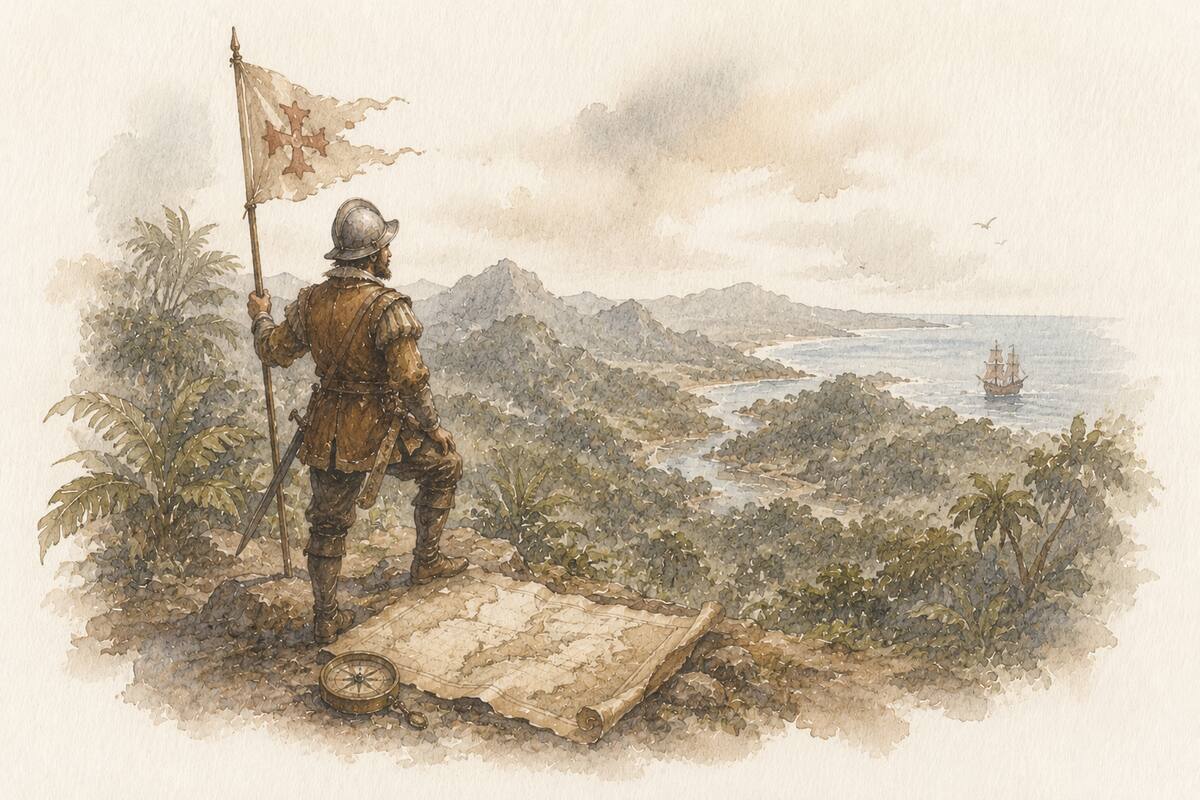
In November 1564 the expedition of Miguel López de Legazpi sailed from New Spain, with Andrés de Urdaneta as cosmographer. It reached the Philippines in 1565 and settled first in Cebu, from where the ship that found the return route to the Americas sailed that same year.
In the following years the Spanish base moved to Panay and, from there, Martín de Goiti and Juan de Salcedo pushed on to Manila Bay, where a settlement ruled by local lords already existed. Legazpi founded the Spanish city of Manila in 1571; it became the capital of the islands and the galleon's Asian port. He died in Manila on 20 August 1572.
The expedition's letters and reports, collected by Blair and Robertson, sit in the corpus alongside modern studies that sometimes credit the same events to different people — for instance, who gave Luzon the name Nueva Castilla.
251 statements51 sources1 discrepancies
Ask the atlas →How did Legazpi's expedition found Manila?
Where the sources disagree
Who named Luzon “Nueva Castilla”?
Felipe II grants the title of 'New Castilla' to Luzón.
Governor Miguel López de Legazpi gave the island of Luzon the name 'New Kingdom of Castilla'.
They may not exclude each other: Legazpi may have coined the name in the islands and the Crown confirmed it later.
Detected automatically · reviewed by a personWhat the sources say
A selection of the corpus statements on this topic, grouped by source.
Conquest of Luzon (Blair & Robertson, Vol. III)
- Melchior de Legazpi certified in Mexico, on March 2, 1573, the detailed expenses of the expedition to the Western Islands, including crews, equipment, provisions, armament, and wages.
- On June 29, 1573, Guido de Lavezaris wrote a document about affairs in the Philippines after Legazpi's death.
Chapter I — Of The First Discoveries Of The Eastern Isles, And Of The Voyage Which (The Philippine Islands, Moluccas, Siam, Cambodia, Japan and China)
- The city of Manila was founded by Miguel López de Legazpi. (p. 39)
Expedition of Villalobos (Blair & Robertson, Vol. II)
- With the arrival of Legazpi in 1564, the Spanish occupation of the Philippine Islands was continuous and complete until 1898, with the exception of a brief period after the capture of Manila by the English in 1762.
Relation of Discoveries (Blair & Robertson, Vol. III)
- On September 1, 1564, instructions were given to Miguel López de Legazpi, who had been appointed governor and general of the discovery of the Western Islands.
Possession of Luzon (Blair & Robertson, Vol. III)
- Miguel López de Legazpi received a letter from King Philip II dated November 16, 1568, brought by Captain Joan de la Ysla on St. John's eve 1569.
Sande to Felipe II (Blair & Robertson, Vol. III)
- In 1569, Lavezaris and Legazpi wrote letters that were sent to the king, including a confirmation of Legazpi's title.
Mirandaola to Felipe II (Blair & Robertson, Vol. III)
- On November 17 of the past year 1570, Governor Miguel López de Legazpi departed from the Panay River to govern.
Los sangleyes chinos en el comercio novohispano
- Fray Andrés de Urdaneta recommended to Viceroy Luis de Velasco that the expedition being prepared at Puerto de Navidad sail from Acapulco in 1564, under the command of Miguel López de Legazpi, who would found Manila in the Philippines. (p. 194, machine-translated)
- In May 1565, Governor Legazpi sent the ship San Pedro de Filipinas, of 500 tons and 200 men, under the command of Felipe de Salcedo and Andrés de Urdaneta, from Cebú to New Spain. (p. 35, machine-translated)
- In April 1565 the fleet anchored at the island of Cebu where Admiral Miguel López de Legazpi founded the town of San Miguel, the first Spanish settlement in the Philippines. (p. 33, machine-translated)
Preface (Blair & Robertson, Vol. II)
- In 1568, Legazpi claimed he had come to make new discoveries for his king, propagate the Christian religion, and ransom Christians held captive by heathens, regarding the Philippines as under Spanish jurisdiction.
- The instructions of the Audiencia to Legazpi on September 1, 1564, stress the necessity of discovering a return route from the Philippines; Urdaneta is ordered to return with the ships sent back to New Spain for this purpose.
Miguel López de Legazpi
- Miguel López de Legazpi died in Manila on 20 August 1572. (machine-translated)
Frequently asked questions
Who founded Manila, and when?
Miguel López de Legazpi founded the Spanish city of Manila in 1571, on top of an earlier settlement on the bay, after the expeditions of Martín de Goiti and Juan de Salcedo.
How is Legazpi connected to the Manila Galleon?
His expedition established the permanent Spanish presence in the Philippines, and the San Pedro, which opened the return route to New Spain, sailed from his base in Cebu in 1565. Manila, which he founded, was the galleon's Asian port for 250 years.
How this page was made: the introduction was written with AI assistance from the project's corpus and checked against its sources. The statements listed are paraphrases extracted automatically from each source (and translated when the source is in another language); they may contain errors, so check the linked original source. Last updated: 2026-10-19.