1574 · Piracy
Limahong's attack on Manila (1574)
The Chinese corsair Limahong (Lin Feng) attacked Manila in 1574. What the chronicles and studies say, and where they disagree: the size of his fleet and whether the city fell or held out.
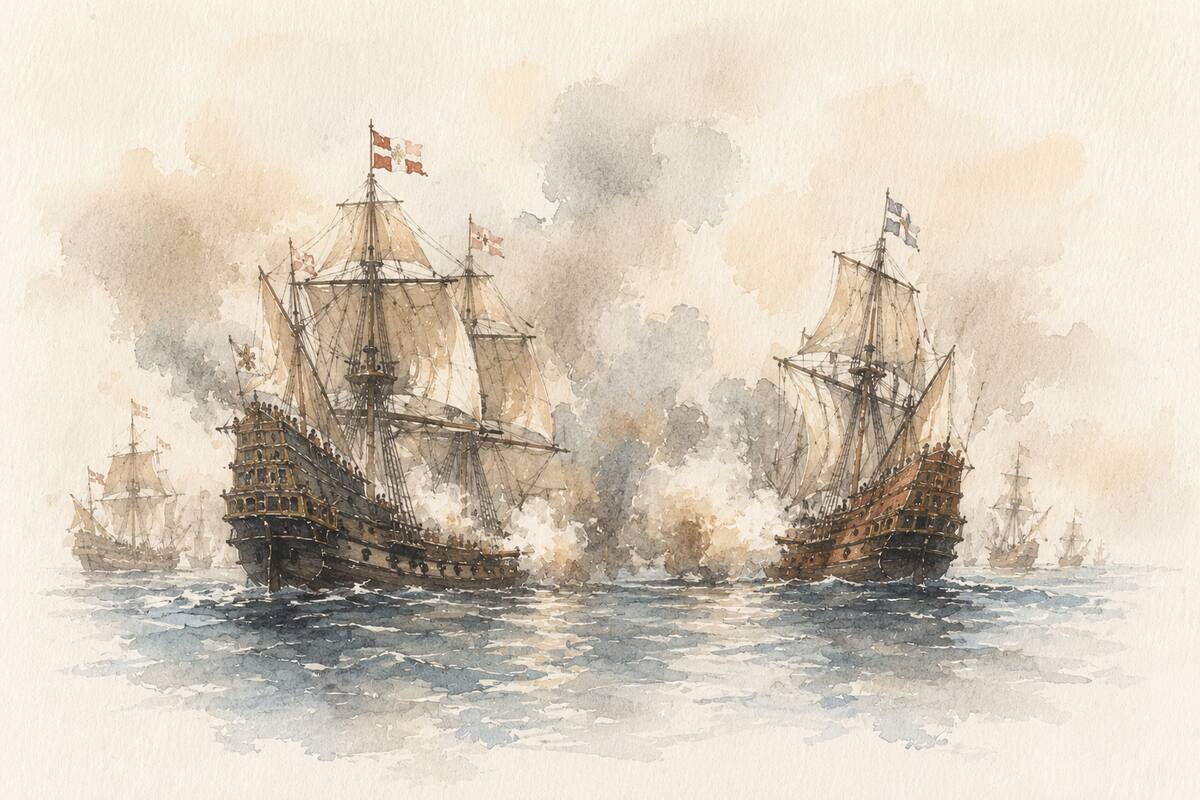
In 1574, barely three years after its founding, Manila was attacked by the fleet of the Chinese corsair Lin Feng, known in Spanish sources as Limahong or Limahón. The town had no walls or stone houses yet, and the assault left much of it burned.
The defenders, led by the field marshal Juan de Salcedo, beat off the attack. Limahong withdrew to Pangasinan, in northern Luzon, where the Spanish besieged him, and he eventually escaped. The hunt for the corsair also opened a diplomatic contact with the Chinese authorities of Fujian.
The sources disagree on specific points: whether Limahong actually took Manila or only set it on fire, how many ships he brought (62 junks according to a modern study, seventy according to Antonio de Morga), and even the date: one study places the attack in April, while the usual chronology puts it at the end of November 1574.
82 statements12 sources2 discrepancies
Ask the atlas →Did Limahong capture Manila in 1574?
Where the sources disagree
Did Limahong take Manila in 1574?
The defense of Manila was vulnerable, as demonstrated by the capture of this capital by Chinese pirate Li-ma-hong in 1574. (machine-translated)
In April 1574, the Chinese pirate Lin Feng, also known as Li-Ma-Hong, attacked Manila and although he failed to take the plaza, he did cause a great fire that destroyed the city's flimsy buildings. (machine-translated)
Both statements may describe the same event with a different emphasis: the town was stormed and burned, but its defenders held out and the corsair withdrew.
Detected automatically · reviewed by a person62 junks or seventy ships?
In 1574, the pirate Lin Feng attacked Manila Bay with a fleet of 62 junks and 10,000 armed men. (machine-translated)
There came the corsair Limahon from China, with seventy large ships and many men-at-arms, against Manila.
Round numbers (“seventy”) are common in chronicles; the figure of 62 junks comes from a modern study. Neither can be verified here without the original sources.
Spotted while preparing this pageWhat the sources say
A selection of the corpus statements on this topic, grouped by source.
Sande's Relation, 1576 (Blair & Robertson, Vol. IV)
- There is a letter from the city of Manila, dated June 2, 1576, that contains an account about the affair of the pirate Limahón.
- The pirate Limahon asked as a condition that the siege be lifted and that the Spanish go to Manila, where he would return to adjust the matter.
- The pirate Limahon sent offers of friendship to the Spanish, saying he would introduce them to the kingdom of China and assist them in conquering it.
History of China (Blair & Robertson, Vol. VI)
- The land force, aided by those who had set the fire, entered the palisade constructed by Limahon for his defense and also in the fortress.
- These expeditions set out with a promise of better results after getting exact news about the capture or death of Limahon.
- Limahon remained in this remote island with his fleet for some days, without daring to return to the mainland.
Sande's Relation, 1577 (Blair & Robertson, Vol. IV)
- The Indians rose up in arms taking advantage of the arrival of pirate Limahon.
- Pirate Limahon arrived and the Indians took advantage to rebel.
Chapter I — Of The First Discoveries Of The Eastern Isles, And Of The Voyage Which (The Philippine Islands, Moluccas, Siam, Cambodia, Japan and China)
- Limahon died of fever on a desert island. (p. 40)
Relación de las Islas Filipinas y de lo que en ellas han trabajado los padres de la Compañía de Jesús
- which was being besieged by the corsair Limahón at a time when it had no fortifications, walls or even stone houses (p. 17, machine-translated)
Los sangleyes chinos en el comercio novohispano
- The Spaniards offered to help Wang Wanggao manage a settlement in southern China in exchange for capturing the pirate Lin Feng. (p. 88, machine-translated)
- Lin Feng initially defeated the Spanish in Manila, but was later defeated in a second engagement. (p. 88, machine-translated)
La audiencia de Manila y los chinos de Filipinas. Casos de integración en el delito
- In 1574, the Chinese in the Philippines, at the call of the Sangleys, revolted with an attack led by the pirate Limahong against the Spanish. (p. 15, machine-translated)
Reseña histórica de Filipinas desde su descubrimiento hasta 1903
- A Chinese pirate named Limahong landed in Parañaque and almost reached Manila. (p. 11, machine-translated)
Frequently asked questions
Who was Limahong?
A Chinese corsair, Lin Feng, who operated along the coast of China and in 1574 led his fleet against Manila. Spanish sources call him Limahong, Limahón or Li-Ma-Hong.
Did Limahong capture Manila?
He did not manage to hold it: he was driven off, although he caused a great fire. A Real Academia de la Historia biography speaks of the “taking” of the capital, while another source says he failed to take the town — the same assault told as a sack or as a successful defence.
How this page was made: the introduction was written with AI assistance from the project's corpus and checked against its sources. The statements listed are paraphrases extracted automatically from each source (and translated when the source is in another language); they may contain errors, so check the linked original source. Last updated: 2026-10-19.