1579–1743 · War in the Pacific
Privateers against the Manila Galleon
From Drake in 1579 to the capture of the Santa Ana by Cavendish (1587) and of the Covadonga by Anson (1743): English attacks on the galleon according to the sources, and their discrepancies.
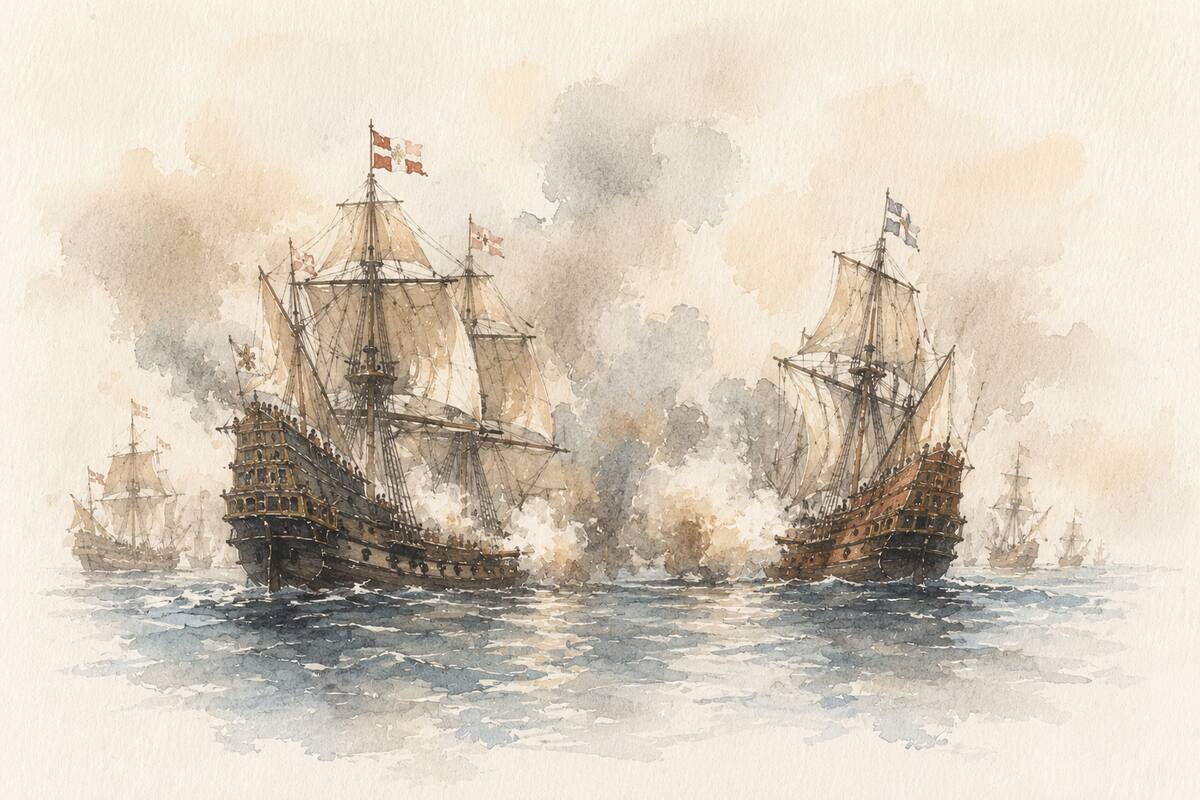
The wealth crossing the Pacific drew the enemies of the Spanish monarchy. Francis Drake spread alarm along the Pacific coast of the Americas and reached California in 1579. Eight years later Thomas Cavendish captured the galleon Santa Ana off Cabo San Lucas, Baja California — one of the richest ever to leave the Philippines — plundered it and set it on fire.
The most famous capture came in 1743: Commodore George Anson's squadron, which had left England in 1740 and sacked the Peruvian port of Paita, seized the Nuestra Señora de Covadonga off Cape Espíritu Santo in the Philippines, with a cargo of about one and a half million silver pesos. These were exceptions: according to one source, only four of 192 galleons were captured.
The sources agree on the essentials but not always on dates: one study places the capture of the Covadonga in 1740, the year Anson sailed from England.
62 statements16 sources2 discrepancies
Ask the atlas →Which Manila galleons did Cavendish and Anson capture?
Where the sources disagree
Where did Cavendish capture the Santa Ana?
The British privateer Cavendish boarded the Manila galleon near Cape Santa Ana on November 14, 1587, captured the crew, burned the ship, and obtained a booty of 122,000 pesos in gold. (machine-translated)
In November 1587, the English pirate Thomas Cavendish captured the Spanish galleon Santa Ana near Cabo San Lucas. (machine-translated)
Most sources place the capture of the Santa Ana off Cabo San Lucas, at the tip of the Baja California peninsula; the mention of a “Cape Santa Ana” may be a mix-up with the ship's name.
Spotted while preparing this pageWhen was the Covadonga captured: 1740 or 1743?
The ship 'Nuestra Señora de Covadonga' was captured by Commodore Anson in 1740. (machine-translated)
In 1743, Commodore Anson's expedition seized the galleon Nuestra Señora de Covadonga off Cape Espíritu Santo (Philippines), a ship plying the route between Acapulco and Manila loaded with a million and a half reales de a ocho. (machine-translated)
The accepted date for the capture of the Covadonga is 1743; 1740 is the year Anson's squadron left England, which probably explains the mix-up.
Spotted while preparing this pageWhat the sources say
A selection of the corpus statements on this topic, grouped by source.
Los sangleyes chinos en el comercio novohispano
- The Manila galleon Santa Ana, expected in November 1587, arrived in Acapulco in May 1588 in a deplorable state after having been attacked and all its cargo stolen by the English corsair Thomas Cavendish, who with his ships Desire and Content was prowling the port. (p. 197, machine-translated)
- In 1743, pirate George Anson attacked and captured the galleon Nuestra Señora de Covadonga on its voyage from Acapulco to Manila. (p. 197, machine-translated)
- Viceroy Don Martín Henríquez de Almanza dispatched 200 soldiers to defend the port of Acapulco when word spread that Francis Drake ('el Draque') was advancing towards it. (p. 197, machine-translated)
El Pacífico Hispanoamericano: política y comercio asiático en el Imperio Español (1680-1784)
- The capture of the Manila galleon Covadonga by the English privateer Anson in 1743 had a strong impact on the trade of the islands, causing many Filipino and Mexican merchants to feel insecure about continuing to invest in the transpacific route. (p. 186, machine-translated)
- The cycle of decline of traffic between Manila and Acapulco worsened after the capture of the galleon Covadonga by the English pirate Anson. (p. 81, machine-translated)
- Captain Anson sacked Guayaquil and Paita and took the treasures of the Manila Galleon, Covadonga. (p. 72, machine-translated)
Un océano de seda y plata: el universo económico del Galeón de Manila
- George Anson captured the galleon Nuestra Señora de Covadonga off the coast of the Philippines in 1743. (p. 12, machine-translated)
- In 1742, George Anson circumnavigated the New Hispanic coasts and was able to obtain refreshments to continue his voyage to the West. (p. 12, machine-translated)
El puerto de Salagua (Colima) y el Galeón de Manila
- In 1587, the English pirate Thomas Cavendish anchored his fleet in the Colima port of Santiago to replenish supplies. (p. 13, machine-translated)
- In 1579, the English admiral Sir Francis Drake caused panic among the inhabitants of the South Seas. (p. 13, machine-translated)
España y el Pacífico: un breve repaso a las expediciones españolas de los siglos XVI al XVIII
- Over the years, Dutch merchants (Dutch East India Company) and English privateers such as Cavendish and Drake entered the Pacific scene. (p. 1, machine-translated)
Discusiones en torno a las marinerías transpacíficas. El caso de la duplicidad de plazas en el Galeón de Manila Santísima Trinidad, 1752-1753
- In 1740, the ship Nuestra Señora de Covadonga had 223 sailors, of which 15 were from the main crew, 80 were sailors, 32 were artillerymen, and 36 were Spanish grumetes, plus 60 simple grumetes. (p. 23, machine-translated)
Del Celeste Imperio a la Nueva España: importación, distribución y consumo de la loza de la China del periodo Ming tardío en el México virreinal
- The famous British pirate known as Drake arrived in California in 1579 after a long voyage and multiple raids along the American coasts. (p. 9, machine-translated)
Hitos Históricos del Galeón de Manila — Real Academia de la Historia
- In 1741, a British expedition led by Commodore George Anson took advantage of the lack of Spanish coast guards to sack the Peruvian port of Paita and sink the anchored ships. (machine-translated)
Frequently asked questions
How many Manila galleons were captured by enemies?
Very few. One source in the corpus counts four captures out of 192 ships, against 26 wrecks or disappearances. The best-known cases are the Santa Ana (1587), taken by Thomas Cavendish, and the Covadonga (1743), taken by George Anson.
Where did Anson capture the galleon Covadonga?
Off Cape Espíritu Santo, on the island of Samar (Philippines), in 1743, as the galleon was returning from Acapulco laden with silver.
How this page was made: the introduction was written with AI assistance from the project's corpus and checked against its sources. The statements listed are paraphrases extracted automatically from each source (and translated when the source is in another language); they may contain errors, so check the linked original source. Last updated: 2026-10-19.